Does this resonate?
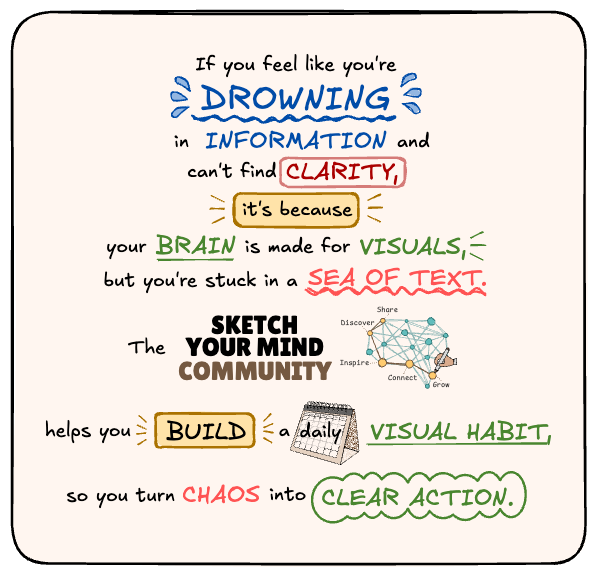
Is it a problem that I just read this post and ignored the pictures until my 3rd rereading? 55 years of reading text probably won’t go away in two weeks. 
3 Likes
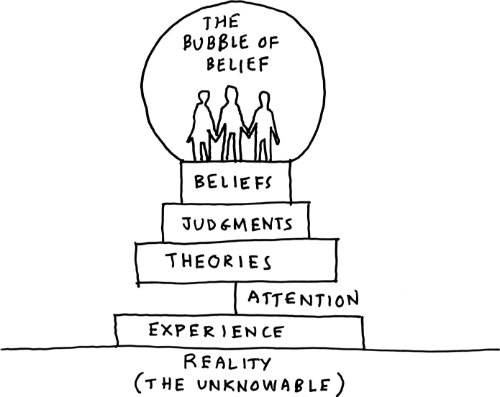
You mean you read the text in the image, but did not notice the calendar icon and the brain? That reminded me of this illustration from Dave Gray’s Liminal Thinking. We filter out 99.9999% (probably more 9s) of information coming our way, else we couldn’t survive.
7 Likes
At first glance, I didn’t know where to look. Everything seemed interesting, and my eyes kept moving back and forth, so at first I didn’t really understand what the text was about. Only when I started reading it like a traditional text from top to bottom did the meaning become clear — and it actually became fun to read.
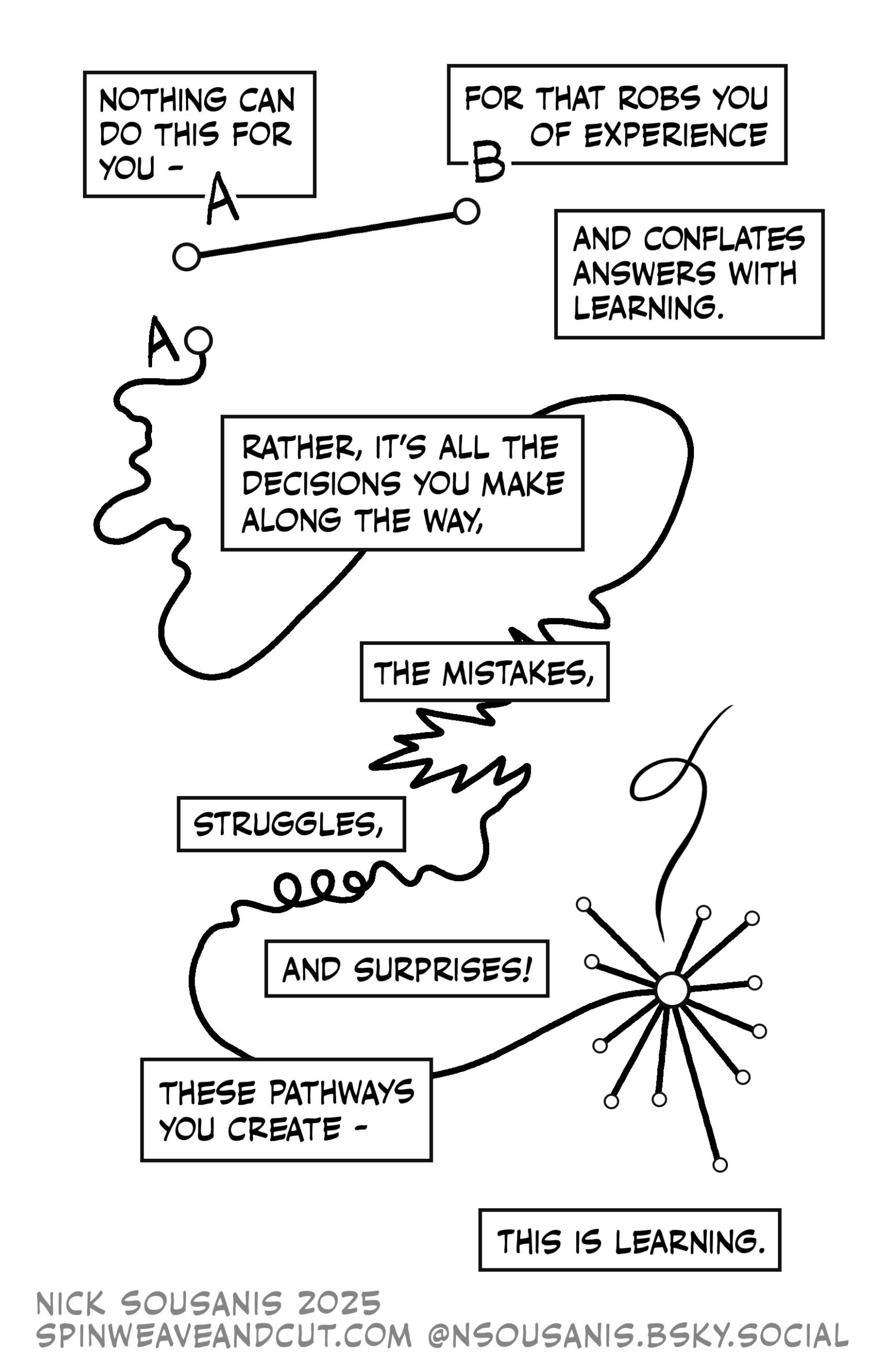
Yeah, I am experimenting with different ways to deliver just text so it is not a wall of text, but something interesting. Some of the inspiration comes from Nick Sousanis
In Nick’s illustrations the lines do help with recognizing the flow:
2 Likes
Reading #5:
Until just now, I thought “SEE OF TEXT” was a typo. But now I SEE it is a play on words.  Well done!
And I never noticed that network of points was supposed to be a brain. It was just a warped Obsidian graph to me. I get it now - second brain.
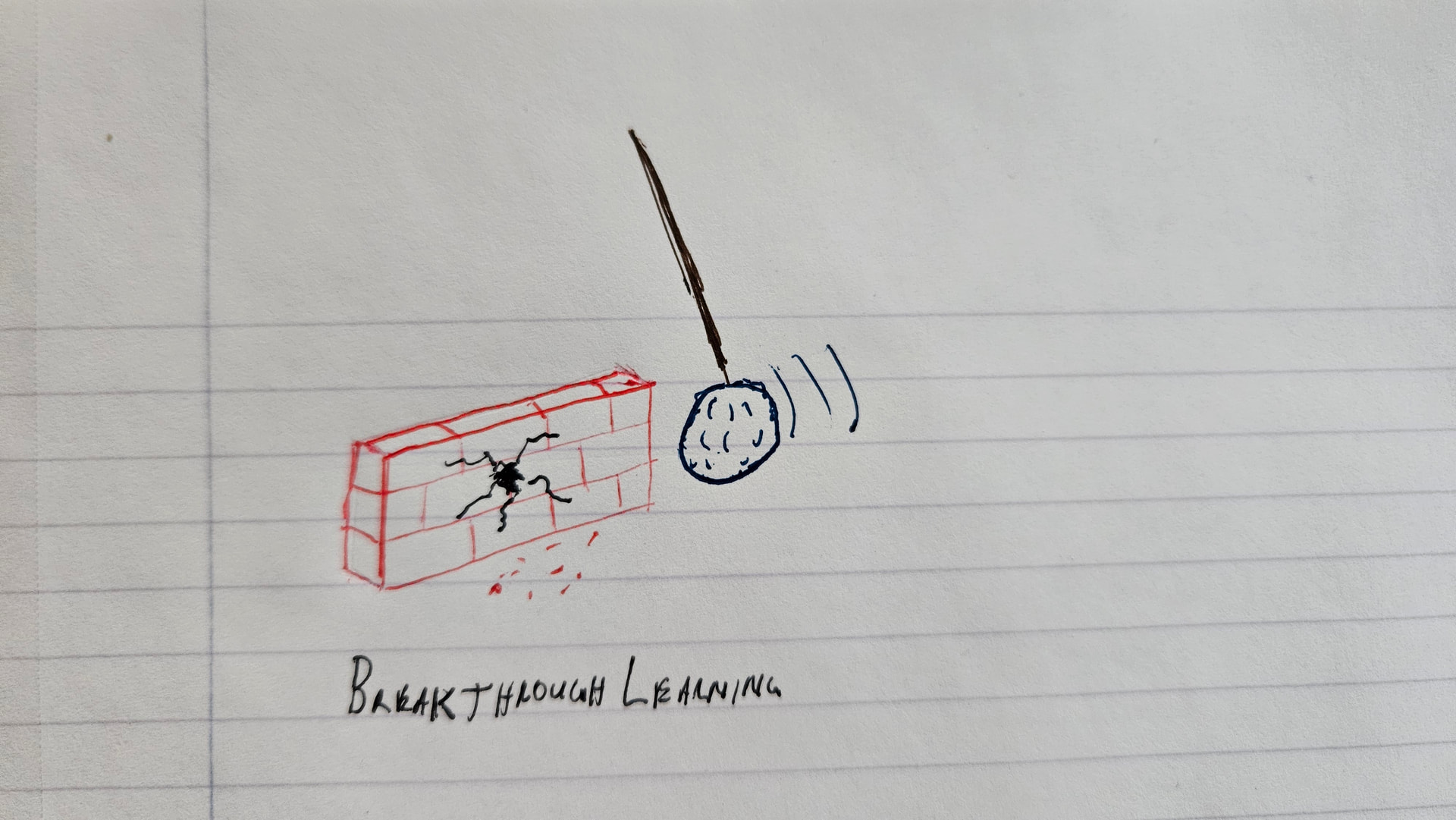
I just stumbled on to Zsolt’s universe and Excalidraw about a month ago, and I’ve only seen a handful of videos, mostly since I started reading the book, and now this site. (Requiring a text to learn visual thinking is sort of ironic, now that I think about it ). I’m finding this work harder than I imagined. So many ingrained habits born out of prior hard work. It’s like I’m relearning how to learn. (Funny, a picture just came to mind about this.) Anyway, trying to absorb Chapter 3 (hybrid notes - awesome! Without this, I would not be pursuing this), and on to Chapter 4 (visualizing concepts - this will break my literal habits).
1 Like
Would love to see that picture 
I have a wall of well earned knowledge. And more is trying to get through. There’s a bit of unlearning required and I’m a bit resistant. I’m also stubborn so I’m not giving up. Anyway, the picture that came to mind.
Oh yeah, I did it on paper because I’m a novice on Excalidraw.
1 Like
I was originally going to use a chisel. The thought was “chippin’ away”. Browsed zillions of icons. Stumbled upon “pickaxe”. So I’m going to start with that if I transfer this to Excalidraw. But by the time I got to drawing it, the wrecking ball prevailed. Funny how the mind works.
1 Like
Showcasing new ExcaliAI features
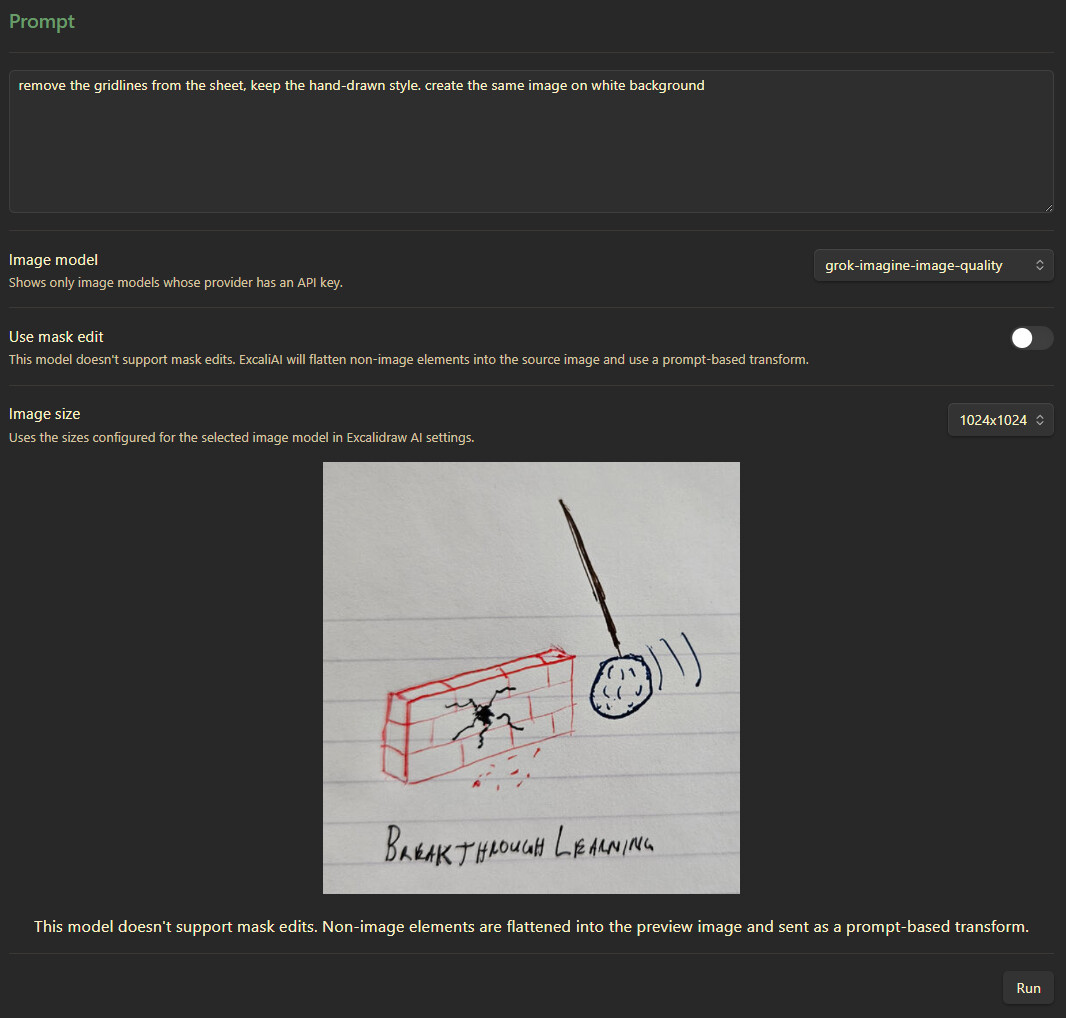
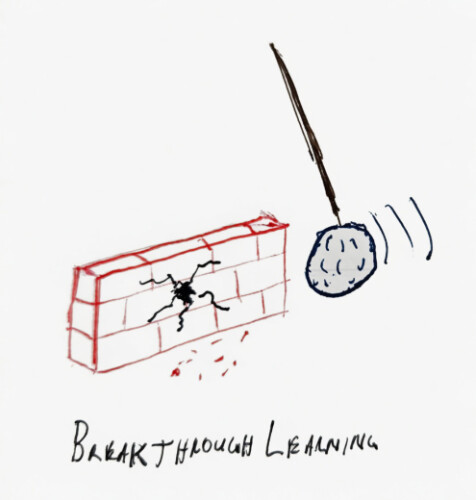
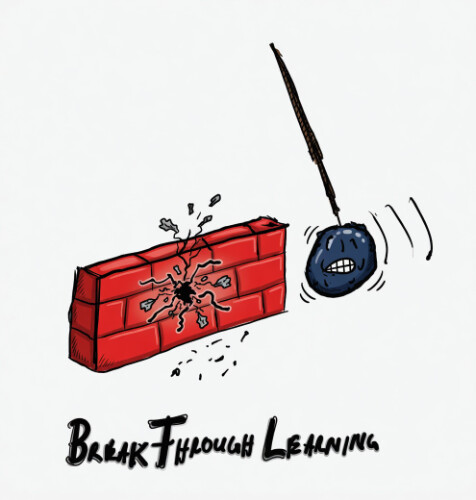
Second Prompt: remove the gridlines from the sheet, keep the hand-drawn style but make it slightly more artistic, more cartoon like. create the same image on white background
2 Likes
Well, isn’t that interesting. Just sent a wrecking ball through my preconceived notions! 


2 Likes
I do appreciate the subtity of the graphics the the concepts being presented. I love the “Back of the Napkin” approach to graphically unfolding ideas. The challenge we have is to allow the unfolding either through flows, panels, or some other form of unfolding. Zsolt, as a higher level concept panel this works. Develop an understanding, some method to unfold.
1 Like
You mean, this is too much for a single glance. Do I understand you correctly?
Sorry Zsolt if this response is in the wrong place. I wonder if there is a way to start upper left and then put the “clarity” upper right then guide the eye down and then produce a path down and then to the left with a flow to guide the reader. As the current presentation is quite dense.
1 Like
When i first looked at it didn’t really resonate because my mind was trying to determine if the colors had any particular meaning. then, when I looked at it a little bit more, I realized the thing that was throwing me off the most was it didn’t seem to be aligned with the principles of your book, especially compared to say chapter 11’s diagrams. Then the final thought I had was, “I wonder what this would look like as a mind map.”
2 Likes
What do you all think of this iteration of the message?
If you feel overwhelmed by information and disconnected ideas, it’s because your brain naturally thinks visually, but most systems trap you in text. Sketch Your Mind helps you build a daily visual thinking habit through sketching, visual PKM, and connected notes, so you can think clearly, create confidently, and turn ideas into action.
or maybe this?
If your notes keep growing but clarity never arrives, it’s because your brain is wired for visuals, not endless walls of text. Sketch Your Mind helps you build a daily visual thinking practice using simple sketches, spatial note-making, and connected visual notes, so you stop collecting information and start turning ideas into clear action.
There are many inputs into our “brain” that are not visual AND they are really, really important to account for in your very fine offering. We have not been using printed text for about 300,000 of the 300,000 years we have been a species. We are quantum and we are whole organisms.
It is helpful to be aware that we see things and we seem to play visual symbols in our “mind’s eye”, BUT we did that with our hands for the vast majority of our existence as a species and as individuals in our own lifetimes.
IMO there is an opportunity to grasp (pun intended) that as a fact of reality about the way we function. Below are some visuals that were used by my physiology prof 50 years ago. My prof was Art Vander and his text book became THE default book for medical training and is in its 19th edition. Art took a small group each semester once a week and reviewed the material with them on a chalk board. He’d draw feedback control loops of physiological functions of every organ system, its myriad interrelations at the most fundamental bonding level of a molecule’s ionic parity because things like an iron atom at the center of a hemoglobin made the 4th oxygen that bind to it have valence that made it available for transport and release at long distances from where it picked up new ones in the lungs…
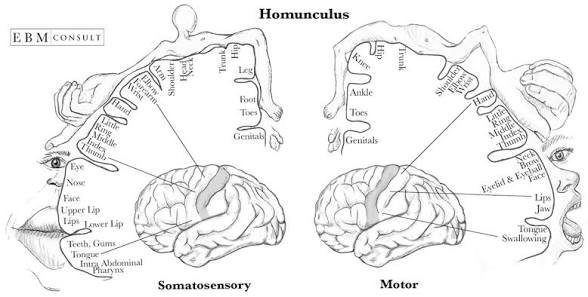
https://sciencedirect.com/science/article/abs/pii/S0001691804001167
The point of my belabored explanation is to emphasize that computer science exploded with Claude Shannon’s masterwork in 1948 (The Mathematical Theory of Communication). It is no accident that Anthropic’s product is called Claude. Shannon used entropy to define the math of coding language. John von Neumann had defined entropy in the 1930 book he wrote in his 20s (The Mathematical Foundation of Quantum Mechanics). He told Shannon to use entropy as the mathematical foundation of information because Claude was using the same formula that Boltzman used to describe heat transmission (and he told him it would help that no one really understands entropy well).
Lost in translation was that von Neumann had defined a more robust entropy in Hilbert space a decade before. The importance is that we as humans are not copper wired as cables under the Atlantic with massive noise obscuring comms between Churchill and Rosevelt. We are biomaterial and our comm channels are massively complex AND quantum too in microtubules that are subcomponents of nerve fibers. Our comm channels are better understood with different metaphors and symbols than the analog wiring that Shannon was engineering for.
IMO the opportunity Zsolt has is to use your programming skills and large user base to dive deeply into making information able to be grasped by one’s hand AND one’s mind. The tablet interface IMO is your opportunity and playground to focus on. “Muscle memory” is an everyday term that our 85 year old grandmothers know, but the underlying reality is that muscle memory operates beginning at quantum interactions and scale out to our ability to grasp ideas with our minds and grasp objects with our hands (and feet).
I have not bought you a cup of coffee, but I have worked through your multi-week international cohort of Excalidraw “students” at a fairly expensive rate for a small business entrepreneur. I feel I have a stake and an opinion worth sharing. I am not attacking you or your product. I am suggesting a premise for it to be much more sticky in its reach and utility by evolving your perspective to include ways in which as a tool it becomes far more valuable and frankly indispensable.
My preference is to collaborate with you to embrace the science and causal power that is simply hiding in plain sight (again pun intended).
Binary digital tools have been massively important to unlocking the growth of knowledge, but the fact is that we are at the Beginning of Infinity (see David Deutsch’s book) when it comes to the growth of knowledge. (√-1=i) and the complex plain is the better math foundation to operate from. Newton’s explanation of physics still suffices to get Elon’s rockets into orbit, but Einstein’s relativity explanations get us GPS which keeps us on track within a few feet moving in our cars after making comm channel trips from out phones to satellites in orbit and back that Newton’s formulas don’t entertain.
I want an Excalidraw tool that trains my biomatter (I call it wetware) to instantiate states of memory storage, reading, computation, and evolved end state descriptions that entail von Neumann’s entropy that is governing our wetware. Claude was well aware of the limitation of his theory. I recommend you do a quick search of his cautionary paper he called “The Bandwagon” to see that “digital” solutions are inadequate for the work you really are trying to build tools for. I conjecture that what you really want is a “Fractal Theory of Geometric Communication Theory” driving a causal inference engine operating on the premises of Judea Pearl’s do-calculus that he was given the Turing Award for about a decade ago. LMK what you think about that…  BoB
BoB
2 Likes
Hi @bishopb0b, great to have you in the community. I’ll send you a DM separately to confirm my records. I’d like to grant you access to the self-paced course here on the new community site. I believe you participated in Cohort 9.
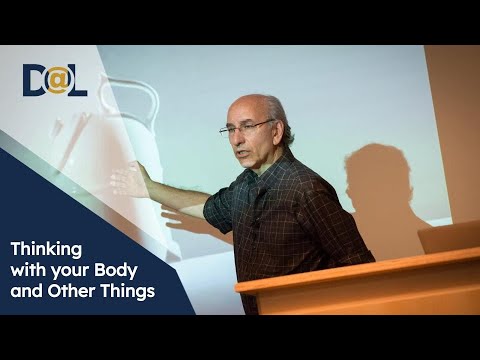
Your note reminded me of this super interesting talk by David Kirsh explaining how thinking evolved from movement.
Can’t add anything to this idea.
But I find it bizarre that I recently picked up Judea Pearl’s book on Why, am reading Beginning of Infinity and re-read high level descriptions of Shannon’s work on entropy as it relates to information gain in internet search.
I suppose it’s not that crazy to believe the algo brought me here as my recent interests surfaced. But it’s strange how it all came together now…

1 Like