Cohort 16 just concluded  . What an amazing team! What an amazing time!
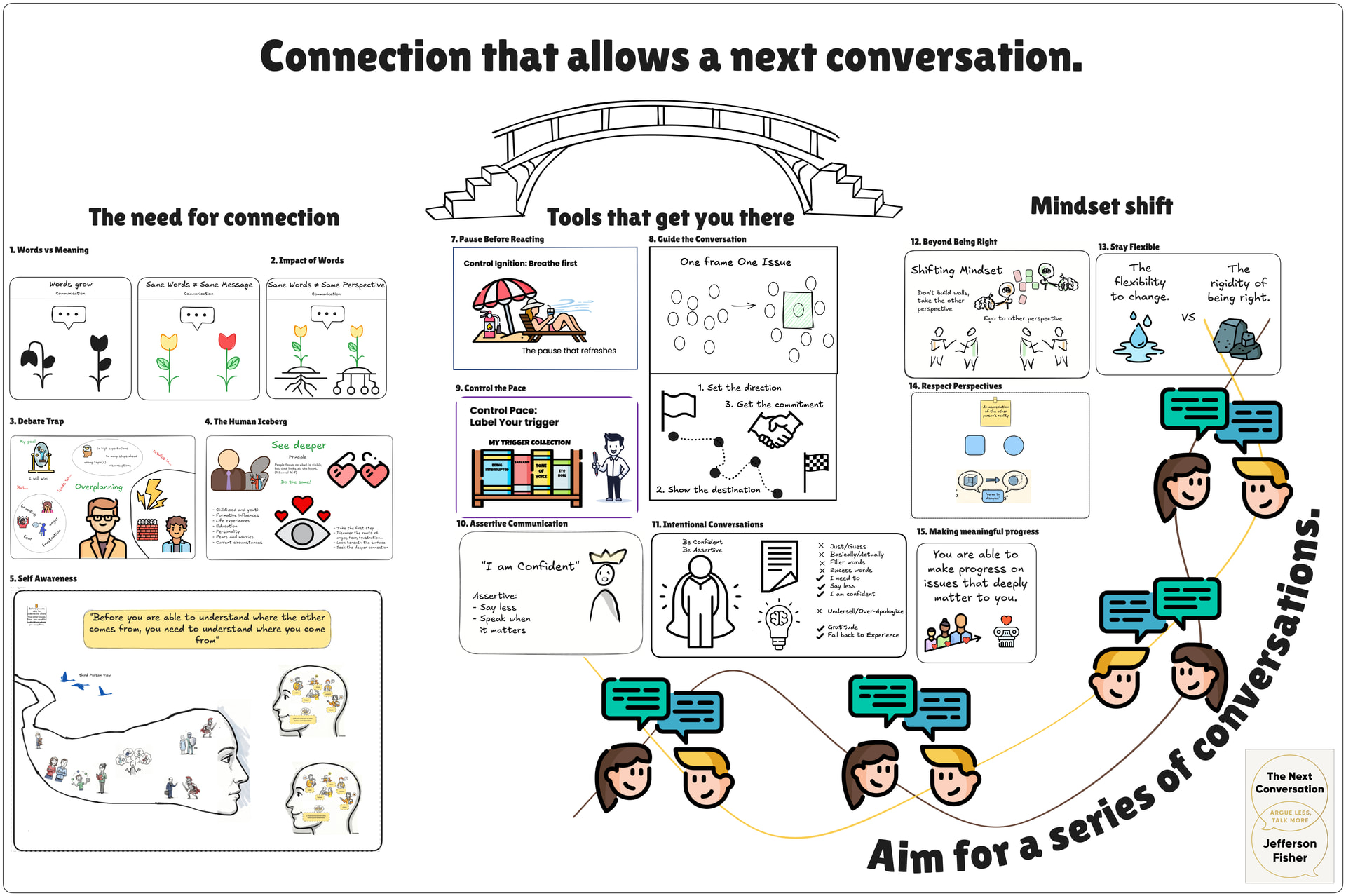
We were reading The Next Conversation by Jefferson Fisher. Here’s the book on a page summary we compiled together during the last session today. Each tile on this BoaP is from a different participant. This is of course rough around the edges… straight from a live session, without post editing.
I also asked Gemini to beautify the BoaP. This is the result Gemini came up with based on our version.
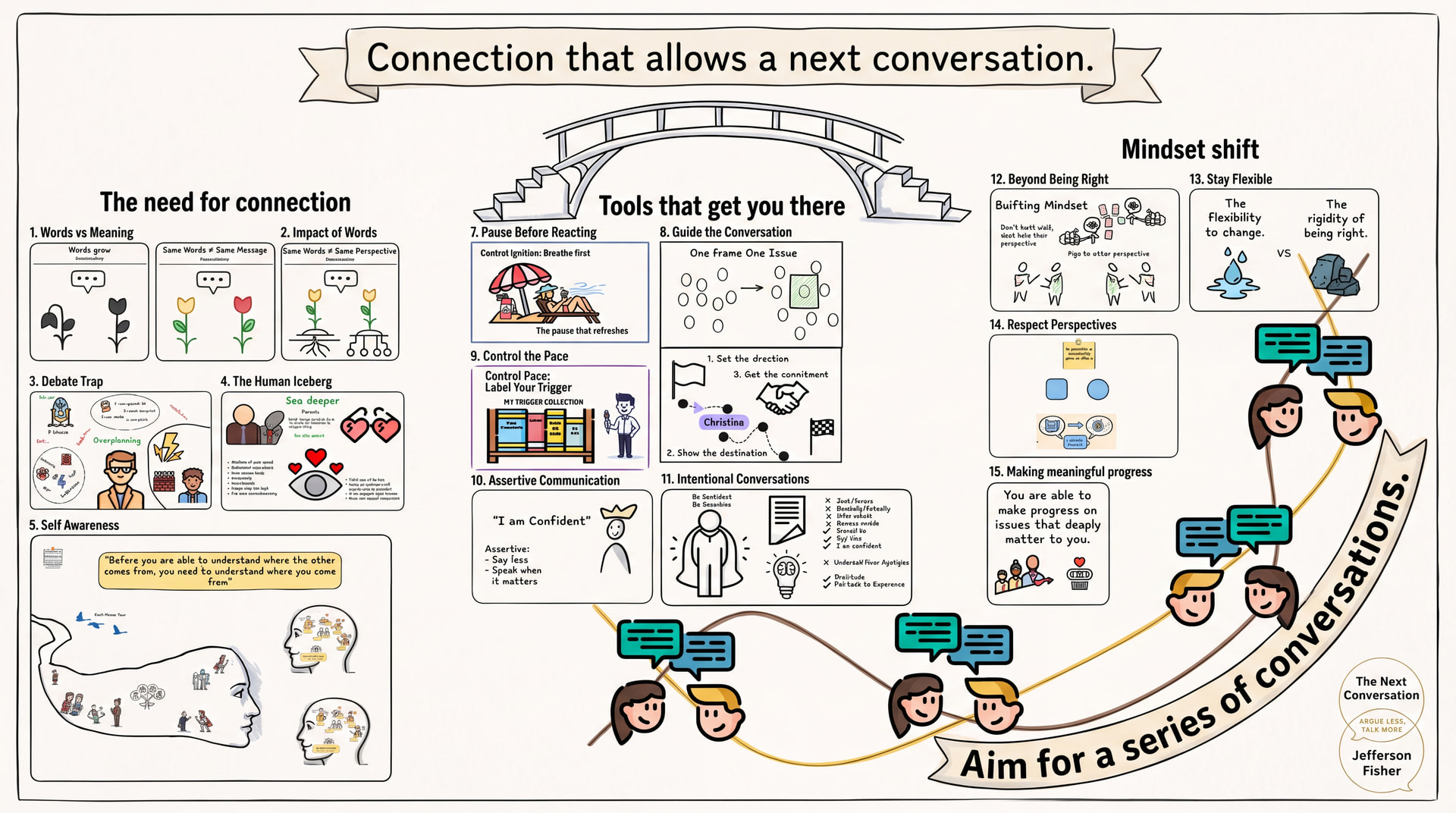
Here’s the story line covered by the illustration, our collective summary of the book as a team:
(1) We hear the same words, but not the same message. Jefferson Fisher’s The Next Conversation starts with a simple but powerful idea: conversations are not just about the words being exchanged. The meaning we receive is shaped by our experiences, emotions, assumptions, and the way those words are delivered. Two people can hear the exact same sentence and walk away with completely different messages.
(2) Because of this, the words we choose matter. The tone, timing, and framing of our message can create long-lasting effects. A single sentence can either open a door for connection or create distance. Good communication is not only about saying what is true; it is about understanding the impact our words have on the other person.
(3) One of the biggest traps in difficult conversations is that we often prepare for a conversation as if it were a debate. We rehearse our arguments, predict the other person’s reactions, and enter the conversation already convinced that we are right. This turns the conversation into a battle where the goal becomes winning instead of understanding.
(4) To move beyond this, Fisher introduces the idea that every person is like an iceberg. We only see the visible part: the words, behaviors, and reactions. Underneath are hidden experiences, beliefs, fears, motivations, and stories that influence how someone responds.
(5) Before we can truly understand another person, we need to understand ourselves. We need awareness of our own triggers, assumptions, and emotional reactions. Many conflicts are not only about the topic being discussed; they are also about what that topic represents to us.
(6) This is where having a communication toolbox becomes important. Difficult conversations are not solved by having the perfect sentence. They require practical tools that help us manage ourselves, understand others, and guide the conversation toward a better outcome.
(7) The first tool is controlling the ignition point of the conversation. Before reacting, create space. Breathe first. Notice what is happening internally. A short pause can prevent an emotional reaction from taking control and give you a chance to respond intentionally.
(8) Next is conversational control. Instead of allowing a conversation to become a collection of arguments, focus on one topic at a time. Understand where the conversation needs to go and guide it toward that destination. Clarity creates progress.
(9) Another important skill is controlling the pace. When we feel attacked, misunderstood, or frustrated, our triggers can quickly take over. By recognizing and naming these triggers, we create distance between the emotion and our response.
(10) Fisher also emphasizes the power of being assertive. Assertiveness is not about being aggressive or dominating the conversation. It means saying less, choosing your words carefully, speaking when it matters, and communicating with confidence.
(11) These tools build confidence because they shift communication from something reactive into something intentional. Instead of hoping conversations go well, we become more capable of shaping them.
(12) A major mindset shift is moving away from the ego’s need to prove itself. A successful conversation is not about showing that we are right. It is about becoming curious enough to see the situation from another person’s perspective.
(13) This requires flexibility. Being unwilling to change our view can become a barrier to connection. Sometimes progress requires letting go of the need to be right and becoming open to learning something new.
(14) At the heart of meaningful communication is appreciation for another person’s reality. We do not need to agree with someone to understand them. We can acknowledge that another person’s experience is real from their perspective.
(15) The goal of a difficult conversation is not to win a single moment. It is to create a connection that allows the next conversation to happen. When we communicate with awareness, confidence, and empathy, we become able to make progress on issues that deeply matter to us.